“What is the smallest elevator? And what size suits a villa?” are among the questions we receive most. The precise answer depends on your own home, so this guide gathers the factors that determine a home elevator’s size, so you go into the consultation knowing what you need.
Car size and shaft size: what is the difference?
The car size is the inner space where passengers stand, while the shaft size is the structural space the elevator travels in. The shaft is larger than the car to accommodate the rails, doors and safety equipment, so when asking about “elevator size” the two must be distinguished.
Factors that determine the right size
1. Number of persons and capacity
In homes, a capacity of 3 to 6 persons is usually enough. The higher the capacity, the larger the car and shaft. Think about the number of family members, and whether the elevator will sometimes carry goods or furniture.
2. Wheelchairs and the elderly
If a family member uses a wheelchair, or you expect that need in the future, plan for a deeper car and a wider door that allow easy entry and turning. This decision is much easier at the design stage than after construction.
3. Number of floors and travel
The number of floors sets the travel distance and affects the suitable elevator type and the requirements below the lowest stop (pit) and above the top stop.
4. New house or existing house?
In a new house you can dedicate a shaft of the ideal size from the start, and we usually recommend a machine-room-less elevator. In an existing house, the elevator is designed around the available space, with solutions using a steel or glass structure, and some models need only a very shallow pit.
5. Elevator location and door layout
Where the elevator sits in the house, and whether the doors are on one side, opposite or adjacent, all affect the final size and everyday comfort.
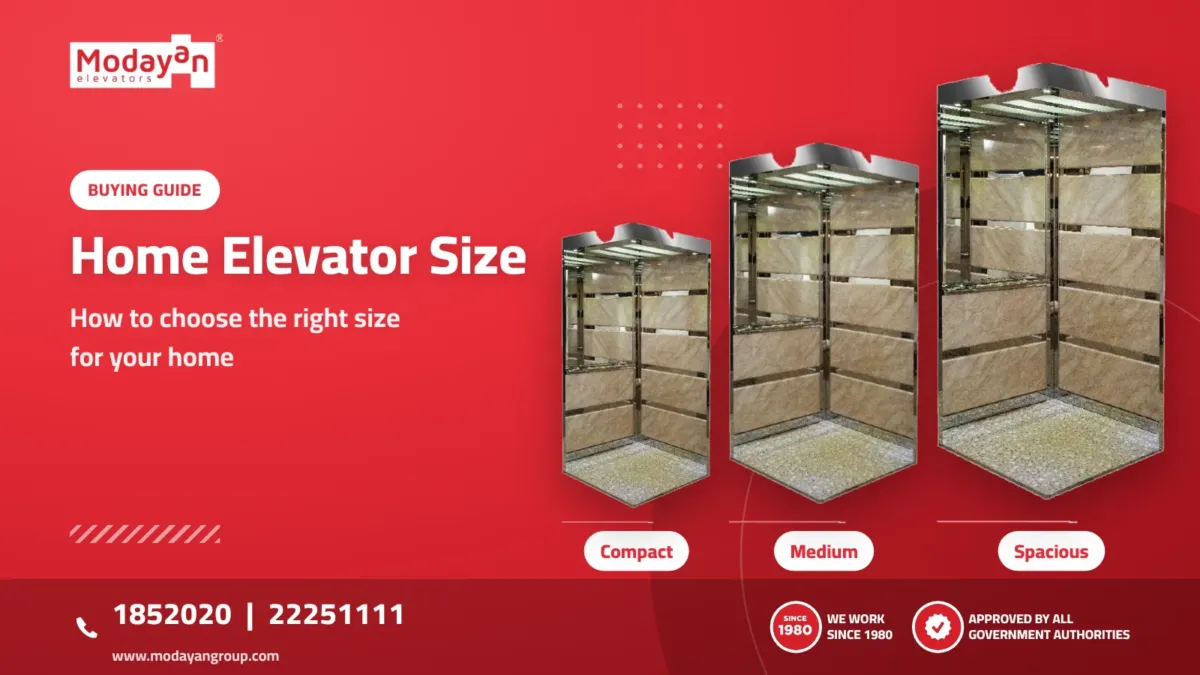
Common home elevator sizes
| Category | Suits | Notes |
|---|---|---|
| Compact | Limited spaces and existing homes | Uses the smallest possible footprint; some models need a very shallow pit |
| Medium | Most private homes and villas | A balance between space and daily family comfort |
| Spacious | Large villas and wheelchair users | Deeper car and wider door, also suitable for moving items |
Exact dimensions for each category vary by model and capacity, and our sales engineer confirms them after reviewing the plan or surveying the site.
What to prepare before the consultation
- The number of floors the elevator will serve.
- The architectural plan, or the shaft dimensions if a shaft exists.
- The number of users, and whether anyone uses a wheelchair.
- Photos of the proposed location if the house is existing.
For the structural details of the shaft, read our article Home Elevator Shaft Dimensions: What to Prepare Before Building, and explore our home elevators.
Our advice
Do not rely on a general figure found online; the right size differs from one home to another. Send us your plan before construction, or request a free site survey, and we will recommend the most suitable size and model for your home.
Frequently asked questions
What is the smallest home elevator available?
Compact solutions are available for limited spaces and existing homes, and some work with a very shallow pit. Our engineer confirms the possible size after a site survey.
How many people does a home elevator carry?
In homes, a capacity of 3 to 6 persons is usually enough, set according to the family size and expected use.
Can I install an elevator in an existing house without a shaft?
Yes, with a steel or glass structure inside or outside the house, or with a platform lift, with minimal demolition.
Your next step
Consultation is free. Our sales engineer will answer your questions and send you a detailed written quotation, and you are welcome to visit our showroom in Shuwaikh to see the samples in person.
Modayan Elevators — since 1980. Contact us: 1852020 – 22251111.